Saturday 10 / October / 2026
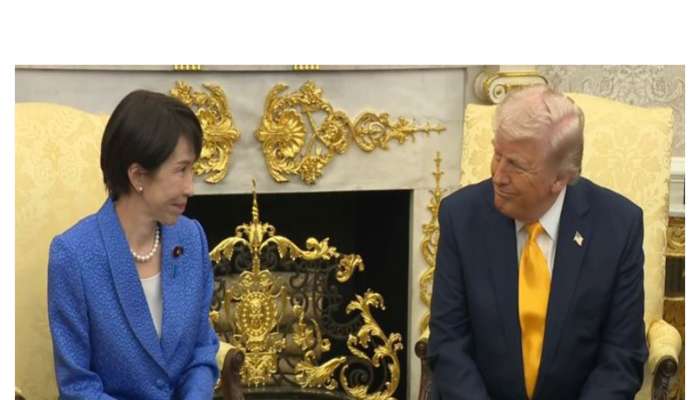
Washington DC: Japan's Prime Minister Sanae Takaichi on Thursday raised concerns over the deteriorating global security environment and underscored the need for coordinated international efforts to address conflicts in the Middle East and beyond, while expressing confidence in US President Donald Trump to play a key role in advancing peace.
"In the Middle East and also the entire world, we are experiencing a severe security environment. I firmly believe that it is only you, Donald, who can achieve peace across the world, and to do so, I am ready to reach out to many of the partners in the international community to achieve our objective together," she said.
She further stressed Japan's firm stance against nuclear proliferation, particularly with regard to Iran.
"Speaking of the situation in Iran, Iran's development of nuclear weapons must never be allowed, and this is why we have been urging them and also reaching out to other partners of the world," she added.
In a separate remark, the Japanese Prime Minister strongly condemned Iran's recent actions in the region.
"Japan condemns Iran's actions, such as attacking the neighbouring regions and also the effective closure of the Strait of Hormuz. Our Minister also urged the Iranian Foreign Minister to stop such activities. The security environment in the Indo-Pacific region is also becoming increasingly severe," she said.
Responding to the remarks, President Trump emphasised the strength of US-Japan ties and welcomed Tokyo's proactive role.
"We've had tremendous support and a relationship with Japan on everything. I believe that, based on statements that were given to us yesterday and the day before yesterday, having to do with Japan, they are really stepping up to the plate," Trump said.
The exchange comes at a time of heightened tensions in the Middle East, particularly over concerns surrounding Iran's nuclear ambitions and disruptions in key maritime routes such as the Strait of Hormuz, a critical artery for global oil shipments.
The visit marks Takaichi's first trip to Washington since assuming office in October 2025. Days after she became Japan's first woman PM, she held her first summit with Trump in Tokyo. Incidentally, in February this year, her Liberal Democratic Party secured a landslide victory in a snap parliamentary election.
Amidst the ongoing US-Israeli war against Iran and Tehran's strikes on Israel and US military bases in the Gulf region, Trump had on Tuesday (local time) walked back on his call for Japan, China, NATO, South Korea and others to send warships to escort tankers through the Strait of Hormuz, a key waterway for transportation of crude oil and gas.
"Because of the fact that we have had such Military Success, we no longer 'need,' or desire, the NATO Countries' assistance -- WE NEVER DID! Likewise, Japan, Australia, or South Korea," Trump wrote on social media.
"In fact, speaking as President of the United States of America, by far the Most Powerful Country Anywhere in the World, WE DO NOT NEED THE HELP OF ANYONE!"
While Japan has not made any statement on the US and Israeli actions, Tokyo has condemned Tehran for its attacks on other countries in West Asia, resulting in civilian casualties.
Japan is a country heavily dependent on oil imports, and Japanese companies are already experiencing price increases of oil products and facing supply restrictions as a result of the blockage in the Strait of Hormuz. The Japanese government has begun releasing oil from its strategic reserves and plans to provide subsidies to help offset the surge in oil prices as per a report in the Washington Post.
Japan historically has maintained friendly relations with Israel and Arab countries, and has positioned itself as a neutral intermediary in other conflicts in the Middle East. Its constitution, adopted after World War II, restricts military operations overseas, and Japan has previously deployed its Self-Defence Forces in April 1991, following the Gulf War, only after a ceasefire was declared, the Post reported.
Takaichi's US visit also comes at a time when there are tensions between Japan and China after her statement in parliament on November 7 that a military attack on Taiwan or a naval blockade by Beijing might constitute a "survival-threatening situation" for Japan, implying that Tokyo could invoke its right to collective self-defence.