Wednesday 21 / October / 2026
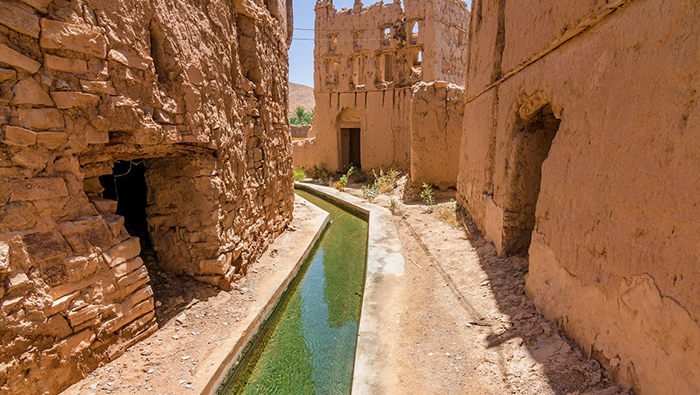
Long before sensors, software, or the phrase “smart grid” entered the vocabulary of modern engineering, a network of hand-carved channels beneath Oman’s mountains was already doing what today’s most advanced water systems aspire to do: moving a precious resource across vast distances, distributing it fairly, and sustaining itself through the collective intelligence of the communities it served.
The falaj system is among the most enduring feats of civil engineering in the ancient world. Archaeological evidence near Bisya dates the earliest systems to around 2500 BC. Five were inscribed as a UNESCO World Heritage Site in 2006, yet they are not museum pieces.
More than 3,000 aflaj remain operational across Oman today, supplying between 30 and 50 percent of the country’s water, according to UNESCO. In many villages, asking about the health of the local falaj remains a routine social exchange.
What makes the falaj remarkable is not just that it works, but how it works. The system is decentralised by design. Water flows through a network of tunnels and surface channels, some stretching over ten kilometres, with access shafts every 20 metres for ventilation and maintenance.
Allocation follows a time-share model, monitored using community sundials, with farms drawing water at scheduled intervals. Disputes are resolved locally. Maintenance is funded through water and land set aside specifically for the system. No central authority controls distribution; the network regulates itself through shared rules, responsibility, and a common understanding that water is a collective resource.
In structural terms, this is strikingly similar to what the modern water industry describes as a smart grid—distributed, responsive, and locally managed rather than centrally controlled.
That same logic now underpins Oman’s modern water strategy. Nama Water Services has installed more than 400,000 smart meters across the country, including over 320,000 in Muscat alone. These provide hourly consumption data, alert users to internal leaks through real-time notifications, and allow the utility to compare distributed volume against household usage to identify system losses.
Working with the National Energy Center, Nama has developed a Meter Data Management system that continuously monitors flow, using AI to flag anomalies before they escalate. Since launching its digital transformation programme in 2021, the utility has reduced water loss by 18 percent (through 2024).
The tools are becoming more sophisticated. Satellite imaging, drone surveillance, and acoustic sensors that detect the sound of water leaks underground are now part of the national strategy, alongside a target to reduce water loss to 10 percent by 2036.
At Oman Water Week 2025, officials from Nama and the Authority for Public Services Regulation outlined plans to integrate AI analytics with advanced metering infrastructure across every governorate.
The technology has evolved. The underlying logic has not. In a country where water has always been the most precious resource, the oldest engineering tradition and the newest are converging on the same insight: the smartest grid is the one that distributes intelligence, not just supply.
(*The author is a student at the British School Muscat and writes about technology)