Monday 31 / August / 2026
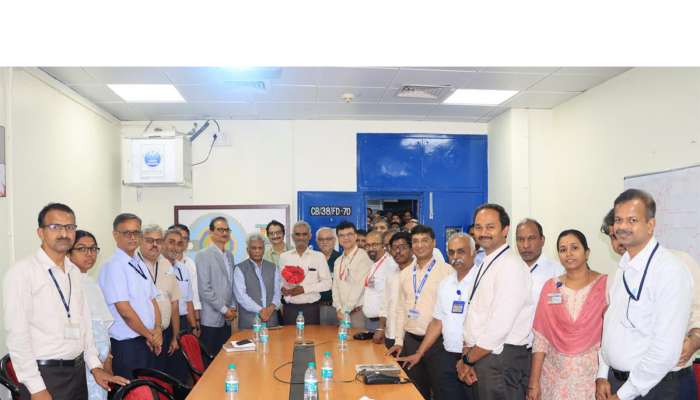
A breakthrough in India’s nuclear power research has been hailed as a defining moment for the country’s energy programme and a step towards self-reliance.
Earlier this month, Indian scientists revealed they had achieved criticality, a state of self-sustaining nuclear chain reaction, at the Kalpakkam prototype fast breeder reactor (PFBR) in Tamil Nadu state.
The programme promises to harness India’s abundant thorium reserves, which constitute around 25 per cent of global deposits, advancing its goal of attaining net zero emissions by 2070.
“This advanced reactor, capable of producing more fuel than it consumes, reflects the depth of our scientific capability and the strength of our engineering enterprise,” Prime Minister Narendra Modi said on social media.
The South Asian nation has limited uranium but massive thorium reserves. Fast breeder reactors are designed to convert thorium-232 into uranium-233, allowing India to eventually switch to the resource to power its energy needs and move away from imported fuel.
Once the prototype becomes fully operational, India will become only the second country after Russia to have a commercial fast breeder reactor.
Traditional pressurised heavy water reactors rely on uranium as fuel and churn out plutonium waste.
A fast breeder reactor uses that ejected plutonium to fuel a self-sustaining nuclear reaction. The advanced technology produces more fissile material – fuel that can be used for nuclear fission – than it consumes.
“PFBR is more than a reactor – it is India’s answer to energy insecurity. A nation that can produce more fuel than it consumes cannot be held hostage to global energy uncertainties,” said R.K. Singh, a senior nuclear scientist and technology leader who previously worked at the Bhabha Atomic Research Centre.
Imports account for roughly 40 per cent of India’s total primary energy needs. It imports between 85-90 per cent of the crude oil that it depends on most, about 50 per cent of its natural gas and significant, though fluctuating, amounts of coal.
This month’s breakthrough came at a time when energy importers worldwide are reeling from a massive disruption in supplies of oil and liquefied natural gas due to the near-closure of the arterial Strait of Hormuz because of the Iran war.
“In today’s world, amid wars and geopolitical arm-twisting, energy can become a tool of control – turning nations into energy dependents. The success of PFBR fundamentally changes that equation for India,” Singh said.
The reactor at Kalpakkam “will use much less nuclear fuel than other reactors and lay a pathway towards a closed fuel cycle”, the International Energy Agency said in a social media post, referring to the reprocessing and recycling of spent nuclear fuel.
Achieving criticality was “symbolically and strategically important”, said Uday Chandra, a political-science professor at Ashoka University, adding that the immediate impact on India’s energy mix was likely to be modest.
Crossing the milestone validated decades of home-grown studies at the Indira Gandhi Centre for Atomic Research and signalled that India was among the few countries capable of running fast breeder systems, he said.
“That matters geopolitically and technologically, especially given constraints on global nuclear technology transfers.”
However, as fast breeder reactors were complex and capital-intensive, “the real importance, therefore, lies in opening a new pathway rather than delivering right away”, Chandra said.
Russia’s BN-800 is currently the world’s only other large operational fast breeder reactor. Most other nations have either abandoned or scaled down their fast breeder programmes due to technical complexities and safety concerns.
India has around 8 gigawatts of installed nuclear capacity, contributing about 3.6 per cent of its electricity. Under its Viksit Bharat vision, the government aims to achieve 100GW of nuclear capacity by 2047.
The PFBR is central to this because it dramatically multiplies fuel efficiency, reducing dependency on imported uranium and laying the foundations for thorium-based power generation.
Under a new law introduced late last year, private Indian and foreign companies are now allowed to build, own and operate nuclear power plants under government licence. Long-standing liability rules that had deterred investors were also eased.
India’s renewed push mirrors a broader global trend, as nuclear plants are increasingly seen as a way to meet baseload demand – or the minimum level of electricity a grid needs.
Self-sustaining nuclear chain reaction could insulate an economy from global commodity price swings and support industrial growth with reliable baseload power, said Srinivaasan Balakrishnan, director of strategic engagements and partnerships at the Indic Researchers Forum think tank in Delhi.
“In an era defined by energy volatility, exacerbated by ongoing tensions in the Middle East and the Russia-Ukraine conflict, the PFBR strengthens India’s strategic autonomy by reducing long-term dependence on imported uranium and fossil fuels,” he said.
The milestone achieved with the Kalpakkam reactor was significant given that even advanced economies such as the US, France, Britain, Japan and Germany had curtailed their fast breeder programmes despite substantial investments, Balakrishnan said.