Monday 27 / July / 2026
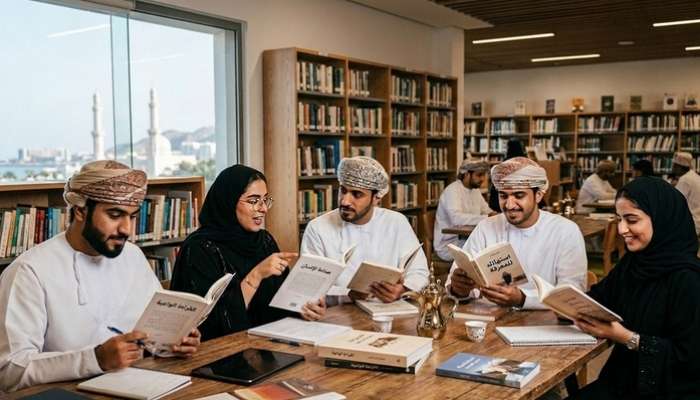
Muscat: In a world of accelerating events and an unprecedented multiplication of information sources, the challenge is no longer access to knowledge, but the ability to understand it and distinguish what builds genuine awareness from what adds mere intellectual noise.
In an age of competing notifications, overlapping digital platforms, and shrinking distances between events and their reception, conscious reading has emerged as a vital tool for restoring intellectual balance, cultivating critical awareness, and reshaping the individual’s relationship with knowledge.
This question takes on deeper significance amid the transformations of contemporary society, where knowledge is no longer simply accumulated information, but a means of shaping the self, forming consciousness, and building the capacity for understanding, analysis and engagement with the world.
A central question arises: how can reading restore human equilibrium in an age of rapid content consumption, particularly among young people?
As life accelerates and space for reflection shrinks beneath the deluge of digital content, writer and cultural enthusiast Labeed bin Mubarak Al Amri argues that conscious reading is no longer a cultural choice but an existential necessity for recalibrating inner balance. Reading, he said, is not merely consuming texts, but an act of “internal engineering” that helps repair the soul and reshape the mind. When one reads, they do not simply store words, but build a mental library that serves as a roadmap for understanding themselves and the world.
The rapid pace of modern life, with its constant notifications and accelerating content, drives people toward intellectual superficiality and diminishes their capacity for reflection, making deep reading a necessary practice to resist fragmentation, he said.
Thoughtful reading is not a withdrawal from reality but a deeper engagement with it, granting individuals the ability to view events from a wider analytical distance, fostering understanding over reaction, and awareness over consumption. Reading, he affirmed, is a counterforce to the culture of rapid consumption, as a deep reader imposes their own intellectual rhythm rather than having it imposed upon them.
The solitude that accompanies reading is not emptiness, but a fertile space for reflection and self‑reconstruction — in contrast to the “digital alienation” experienced amid abundant connectivity yet scarce meaning.
The rise in psychological disorders in the modern era is partly linked to the accelerating digital pace, he noted, suggesting that conscious reading could serve as one of the most important tools for psychological and intellectual balance in this context. Visual artist Sanaa Said Al Humaidi views reading as a fundamental pillar of human development and a strategic tool for building a knowledge society, aligned with Oman Vision 2040, which places human beings at the heart and purpose of development.
Reading, she said, is no longer merely a means of acquiring information but a civilisational practice that shapes individual and collective consciousness, building the intellectual and cultural capital needed to keep pace with rapid global change.
She described reading as an effective tool for developing critical thinking, enhancing creative capacities, and producing knowledge that moves beyond reception to creation and impact. Translating the impact of reading from the individual to the community represents a direct investment in people as the axis of development.
Establishing a reading culture among young people requires an integrated system, she said: beginning with the family as the primary incubator of knowledge, extending to educational institutions that foster thinking and innovation, and reaching cultural and media institutions responsible for entrenching reading as a sustainable societal value.
Reading clubs, intellectual forums, cultural initiatives and exhibitions help transform reading from an individual activity into a productive community movement, opening space for dialogue, expertise exchange and idea generation. Knowledge does not flourish in isolation, but grows through interaction and participation, she added.
Her experience as a visual artist and researcher in culture and leadership has reinforced her conviction that reading is the primary source of creativity, she explained. Any successful artistic work, cultural project or community initiative is preceded by an accumulation of knowledge that enriches the imagination and deepens vision.
Reading is not the consumption of knowledge but its reproduction in more innovative forms, she said. A conscious reader does not simply receive ideas, but reshapes, develops and applies them in reality.
She stressed the importance of moving from traditional reading to interactive reading based on analysis, reflection and connecting knowledge to real‑world contexts. Translating books into intellectual, creative or community projects represents the essence of the true value of reading.
She concluded by affirming that reading serves as a bridge between tradition and modernity, enhances Omani soft power, and helps showcase national cultural achievements regionally and internationally. Reading is not an end in itself, but a means of building individuals capable of thinking, creating and shaping the future.
If the previous perspective focused on reading as an investment in intellectual capital and the building of a knowledge society, Hajer Ali Al Masfari shifts the dialogue toward a deeper dimension: reading’s capacity to transform knowledge into behaviour and shape a value system that guides individuals in their daily decisions — particularly among young people.
She said that while the world today experiences an unprecedented flow of information and speed of access, this does not necessarily translate into higher levels of understanding or deeper knowledge. The essential difference, she stressed, lies between those who consume information and those who transform it into genuine awareness.
Conscious reading is the means by which one distinguishes fleeting information from lasting knowledge, she explained. Its impact may not be immediately apparent, but it accumulates gradually to reshape behaviour and one’s view of self and the world.
She added that fleeting information is consumed quickly and forgotten quickly — news, numbers and daily facts — while lasting knowledge is that which transforms into conviction and principle, reflected in behaviour, thinking and one’s approach to life.
She said that conscious reading is based on reflection, not consumption, and on asking fundamental questions such as: What is the author trying to say? Do I agree? Why? How does this relate to my reality? This kind of reading requires taking notes, connecting meanings and rethinking texts, she said.
She elaborated that a conscious reader is not a passive recipient but a critical reader who seeks meaning rather than quantity, and reads for transformation rather than mere entertainment, she added. True understanding is achieved only through selection, reflection, connection and application.
She explained that transforming knowledge into an internal compass is the essence of conscious reading, through which a person develops a value system that helps them make sound decisions, understand themselves, and distinguish the important from the trivial.
She pointed out that this compass is built through reflective reading, self‑review and applying knowledge in reality. Its effects appear in daily decisions such as choosing relationships, managing time and setting priorities, and are reflected in behaviour through emotional regulation and constructive handling of disagreements.
Different fields of reading produce different behaviours, she added. One who reads about time management becomes more aware of its value; one who reads about ethics reflects that in their fairness and dealings; one who reads biographies learns patience and perseverance.
The greatest obstacle to transforming knowledge into genuine awareness is digital distraction, hasty reading without reflection, and consumption without application, she said. True reading, she stressed, is that which becomes impact, not merely stored information.
Qais Yousef Al Seyabi said that reading itself is an active force in shaping a reader’s consciousness and directing their thinking, alongside other factors that build intellectual character. The level of prior awareness may influence book choice, he explained, but it does not replace the importance of a systematic approach to reading.
The quality of books a reader chooses helps map their thinking and acts as a “magnetic field” guiding their intellectual compass, particularly when reading follows a clear plan rather than randomness, he said.
Random reading, though it broadens horizons and diversifies knowledge, often provides only general, surface‑level understanding, he explained. Systematic reading, by contrast, builds a solid knowledge foundation and enhances the ability to analyse and grasp subjects more deeply.
A reader who follows a well‑considered reading plan, treating each book as a step within an integrated knowledge project, is better equipped for specialisation and deep understanding, he said. -ONA
Setting reading goals — whether as part of a knowledge plan or to deepen intellectual capital — directly affects comprehension quality and the ability to engage in discussion, analysis, and forming well‑grounded opinions, he emphasised.
Systematic reading provides a broader linguistic and terminological foundation, and enhances objectivity and sound judgment on various issues, compared to unstructured reading, he noted.
A reader who consciously charts their reading path becomes more independent in thought, and more capable of building convictions based on understanding and analysis rather than quick impressions or fleeting influences, he affirmed.
The contributors agreed that the future of societies is measured not by the quantity of available information, but by the ability of individuals to transform information into knowledge, knowledge into behaviour, and behaviour into impact — advancing the building of a knowledge society.