Monday 17 / August / 2026
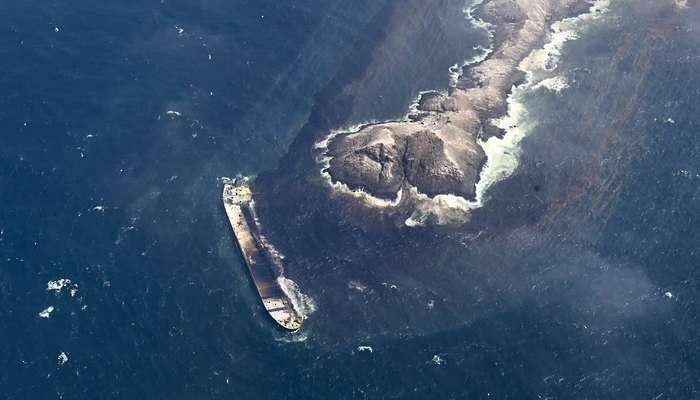
Muscat: The Ministry of Transport, Communications and Information Technology continues its salvage and oil spill containment operations involving the tanker 'Caroline Bezengi', which is stranded on a rocky outcrop near Al Qibliyah Island in the Al Hallaniyat Islands archipelago in Dhofar Governorate. These efforts are exerted in cooperation with the relevant national authorities and international experts from the British company Ambrey.
These efforts are being carried out amid extremely challenging weather conditions, with wind speeds at times reaching around 40 knots and sea waves rising to approximately four metres, making it extremely difficult and complex to approach the vessel by sea or air.
Mohammed Abdullah Al Rawahi, Director General of Maritime Affairs at the Ministry of Transport, Communications and Information Technology, said that the Ministry has, from the outset, intensified its efforts to mitigate the potential environmental impacts resulting from the vessel’s grounding.
In coordination with the British company Ambrey, the Ministry appointed specialised companies in oil spill response and pollution control, including the international company Oil Spill Response Limited (OSRL) and the national company OMAN PESCO, to participate in pollution response operations and the clean-up of affected areas.
He added that the Ministry coordinated with Ambrey to import and prepare pollution-control materials and equipment, including rubber booms, response equipment and materials, and chemical dispersants, in addition to providing a specialised vessel to transport and operate this equipment and these materials at the incident site.
The Ministry continues to coordinate with Ambrey and the specialised companies appointed by it, in cooperation with the Environment Authority and the relevant national authorities, to ensure the readiness of the necessary resources and equipment and their deployment whenever weather and sea conditions permit, in accordance with the approved environmental and technical assessments and requirements.
He explained that the difficult weather conditions during the Khareef (monsoon) season, accompanied by strong winds and high sea waves, have created exceptional technical and operational challenges that have made it extremely difficult to approach the vessel safely and have limited the implementation of the required marine operations.
In addition, the waters surrounding the vessel’s grounding site are shallow and rocky, with limited precise marine and hydrographic data available to determine water depths and safe approach routes.
He stressed that this has posed an additional challenge for support vessels, whose operation near the grounded vessel requires a high degree of precision to ensure safety. Accordingly, bringing salvage vessels and marine equipment close to the incident site under the current conditions entails operational and navigational risks, which has necessitated exploring alternative means of reaching the vessel and supporting the teams working on board.
He added that the challenges are not limited to the conditions surrounding the vessel, but also extend to the technical condition of the vessel itself, as it is grounded on a rocky area and listing at approximately 17 degrees, resulting in a large part of one side being submerged and making movement and work on board more difficult.
He noted that the presence of oil and seawater on the vessel’s deck, combined with strong waves and winds, has made some work areas slippery and unsafe, while there is no reliable operational power source on board to operate the equipment required for salvage operations. Under these conditions, cargo transfer operations or heavy work cannot begin before minimum safety requirements are met and work areas on board the vessel are secured.
He stated that the Ministry of Transport, Communications and Information Technology, in coordination with the relevant national authorities, engaged the international company Ambrey, given its extensive experience and expertise in handling marine salvage operations involving incidents of this nature. A large number of these experts described the task of dealing with the difficult and complex situation of the oil tanker stranded at Al Qibliyah Islands as one of the most difficult and complex cases. Technical teams from the Ministry and the relevant national authorities, together with international experts, are developing realistic, phased plans suited to the exceptional condition of the vessel and the surrounding marine conditions.
The Director General of Maritime Affairs at the Ministry of Transport, Communications and Information Technology added that the current priority is to secure a suitable and safe working environment for the technical teams by cleaning and preparing work areas, conducting safety inspections and gas and oxygen measurements, identifying suitable locations for installing equipment, and preparing and transporting generators, technical equipment and the necessary salvage equipment to enable the teams to carry out subsequent operations.
He pointed out that, as some of this equipment cannot be transported by sea under the current conditions, aerial support is being used to transport experts and equipment onto the vessel’s deck, allowing technical and preparatory work to continue until sea conditions improve and support vessels are able to approach safely.
He noted that, in parallel with securing the working environment, the technical teams are assessing and implementing possible solutions to limit the continued leakage and maintain, as far as possible, the stability of the vessel and its cargo. Among the technical options being pursued is the internal transfer of oil from damaged tanks to intact and safe tanks within the vessel, whenever the vessel’s condition and safety requirements permit, with the aim of reducing the quantity of oil exposed to leakage and limiting the pressures and risks associated with the damaged tanks.
He explained that this process requires the preparation of power equipment, pumps and supporting equipment, in addition to continuous verification of the vessel’s stability, the integrity of the tanks and the operational conditions before any internal transfer operation is carried out.
He also explained that marine and hydrographic surveys are being conducted in the areas surrounding the vessel and along the routes approaching it, with the aim of providing accurate data on water depths, the nature of the seabed and navigational hazards, and identifying safe routes and locations that can be used by salvage and support vessels during the upcoming stages. He said these surveys represent an essential step before vessels with a deep draught are allowed to enter the vicinity of the grounded vessel, particularly given the rocky and shallow nature of the area.
He indicated that these measures collectively aim to create the conditions necessary to move safely to the main phase of the operation, namely transferring the oil cargo from the grounded vessel to another vessel equipped for this purpose. Reaching this stage requires completing the process of securing the working environment on board the vessel, providing power sources and equipment, addressing the risks associated with the damaged tanks, completing the marine surveys, identifying safe locations and approach routes for support vessels, and selecting a suitable offshore location for carrying out the operation.
He stressed that the phased implementation of these operations is based on safety considerations and the continuous technical assessment of the situation, with the safety of the teams, protection of the marine environment and prevention of any deterioration in the vessel’s condition remaining key priorities.
Mohammed Abdullah Al Rawahi, Director General of Maritime Affairs at the Ministry of Transport, Communications and Information Technology, indicated that the Ministry, in coordination with the relevant national authorities, Ambrey and international experts, continues to follow up on the implementation of these operations and to work on providing the necessary technical and logistical requirements, with the aim of carrying out the cargo transfer operation and handling the vessel with the highest possible level of safety and efficiency when weather conditions permit.