Monday 21 / September / 2026
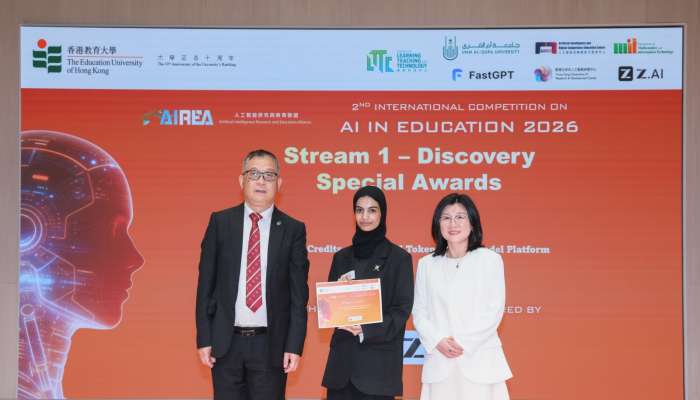
Muscat: Artificial intelligence is emerging as a key force shaping the future of education, business and other sectors, as Oman accelerates its digital transformation and efforts to build a sustainable, knowledge-based economy.
Against this backdrop, a growing generation of young Omani innovators is using advanced technologies to develop practical solutions to real-world challenges, demonstrating that youth can play an active role in shaping the country’s digital future rather than simply consuming new technologies.
Among these emerging talents is Nouf bint Abdul Hamid Al Shamli, an Omani student at Sultan Qaboos University specialising in statistics, data science and computer science. She is also a founding partner of “Elmfy,” an artificial intelligence-powered educational platform designed to personalise learning and improve academic efficiency for university students.
The platform has expanded beyond Oman through a number of pilot projects, reflecting the potential of locally developed digital solutions to compete at regional and international levels.
Speaking to the Oman News Agency, Al Shamli said her decision to combine statistics, data science and computer science was based on her belief that modern technology depends on the integration of numbers, data and programming.
She explained that statistics enables her to understand data, identify patterns and predict trends, while computer science provides the tools needed to transform that understanding into practical technological solutions.
According to Al Shamli, this combination has shaped her approach to artificial intelligence, which she views as a system fundamentally built on data, statistical models and algorithms. Understanding these foundations, she said, is essential for developing reliable and meaningful AI applications.
She stressed that the real value of combining these disciplines lies in the ability to examine a problem from several perspectives, including the reliability of data, the accuracy of models and the scalability of technological applications.
Conscious use of AI
Al Shamli said AI skills should not be measured simply by a person's ability to operate available tools, as access to such technologies has become increasingly widespread.
Instead, she believes the real distinction lies in knowing when to use AI, how to direct it and what purpose it should serve.
She identified three characteristics of effective AI users: the ability to ask the right questions, strong knowledge of the field in which AI is being applied, and an ethical and responsible approach that ensures technology serves humanity rather than replaces it.
She added that professionals who develop these capabilities can improve productivity, identify opportunities more quickly and develop solutions that might not emerge through traditional approaches alone.
Data at the heart of decision-making
Al Shamli also highlighted the importance of data science, noting that data by itself does not create value. Its value emerges when it is collected accurately, sourced transparently and analysed in a way that supports decision-making.
She said effective data science can give institutions a more proactive understanding of emerging needs rather than relying solely on delayed responses.
Data-driven approaches can also contribute to more efficient allocation of resources by providing decision-makers with a clearer picture of actual requirements.
The idea behind Elmfy emerged from Al Shamli's own experience of struggling to understand some academic material through conventional teaching methods.
The challenge prompted the idea of creating a learning experience capable of adapting to individual learners rather than requiring students to follow a single standard approach.
Working with her technical colleague, she developed the concept further and gained experience beyond her core academic specialisations, including marketing, branding, financial planning, budgeting and engagement with users, investors, reviewers and partners.
The platform participated in a number of local and international exhibitions and competitions, with each experience and feedback helping the team refine its concept.
One of the major milestones was representing Oman at the Falling Walls competition in Berlin last year, where the team had the opportunity to compare its idea with innovative projects from around the world.
Al Shamli said the experience helped the team gain a clearer understanding of what distinguishes Elmfy from other educational technology solutions.
She said the team hopes to contribute to the future of smart education in Oman by offering learning that adapts to students, using technology to facilitate rather than complicate education, and developing an authentic Arab educational model capable of competing internationally.
Understanding the problem before finding the solution
Al Shamli described winning the “Early Problem Detection” award as a turning point in her understanding of innovation.
She said innovation is often associated with developing a smart solution, but the most important stage may come before the solution itself: accurately identifying and understanding the underlying problem.
She noted that projects can fail not necessarily because their solutions are weak, but because they attempt to solve problems that were incorrectly defined or did not exist in the assumed form.
Listening carefully to people experiencing the problem, studying the surrounding context and analysing available data, she said, are essential steps in developing solutions capable of creating genuine impact.
Continuous learning as a necessity
For Al Shamli, continuous learning is central to her professional development, particularly in the rapidly changing field of artificial intelligence.
She said technologies considered advanced yesterday can quickly become outdated, making continuous education essential for anyone seeking to remain competitive.
Her approach includes following developments in AI, participating in competitions and specialised training programmes, gaining practical experience and learning from colleagues and projects, including those that encounter difficulties.
She also highlighted self-learning as an important factor in developing technical flexibility, confidence in dealing with unfamiliar challenges and the ability to move between different fields.
She believes learning should be treated as a daily practice rather than something that ends with university graduation.
Opportunities for Omani youth
Al Shamli said Omani youth are facing a significant opportunity in AI and data science, supported by the country's growing focus on digital transformation and increasing interest in innovation and entrepreneurship.
She identified education, healthcare, infrastructure and tourism among the sectors where locally developed AI solutions could have particular potential.
Global technologies, she noted, do not always fully reflect the requirements and characteristics of the Omani market. This creates opportunities for young people who combine technical expertise with a strong understanding of local needs.
She identified three elements that can help young people move from being technology users to creators of globally competitive products: the courage to launch a real project, building diverse and cohesive teams, and viewing the local market as a starting point rather than an endpoint.
When these elements come together, she said, Omani youth can become active partners in shaping the digital future and contribute innovative solutions capable of reaching regional and global markets.