Thursday 01 / January / 2026
Muscat: The total estimated revenues for the Sultanate of Oman's General State Budget for 2026, calculated based on an average oil price of 60 US Dollars per barrel, amounted to approximately RO 11.447 billion. This reflects an increase of 2.4 percent over the approved revenues for 2025.
Total public expenditure was estimated at approximately RO 11.977 billion, rising by 1.5 percent from the approved expenditure for 2025. Meanwhile, the estimated budget deficit for 2026 stands at approximately RO 530 million, a decrease of 14.5 percent from the deficit approved in the 2025 budget, constituting 4.6 percent of total revenues and 1.3 percent of the Gross Domestic Product (GDP).
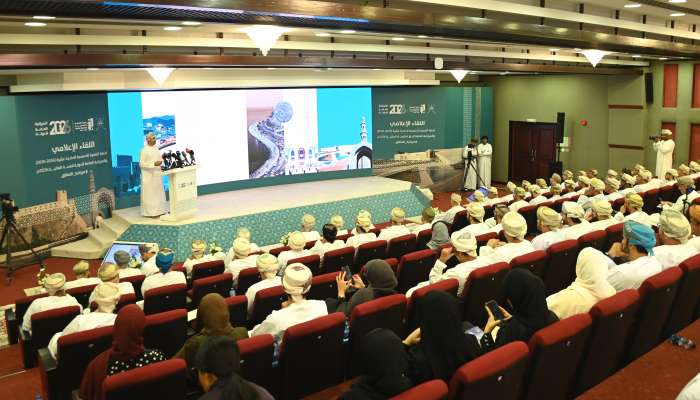
This was announced during a press conference held today at the Ministry of Finance to disclose details of the financial framework for the Eleventh Five-Year Development Plan (2026-2030) and the General State Budget for the fiscal year 2026, in addition to the preliminary results of the General State Budget for the fiscal year 2025.
Sultan Salim Al-Habsi, Minister of Finance, affirmed the continued growth of Oman's economic activity. Statistical data indicates that the projected real GDP (at constant prices) by the end of 2025 is expected to reach approximately RO 39.2 billion, compared to RO 34.5 billion at the end of 2021, achieving a growth rate of 14 percent since the start of the (Tenth) Plan. Furthermore, inflation rates have stabilized within target ranges, with the average inflation rate until November 2025 recorded at around 0.9 percent. This outcome is attributed to government policies supporting petroleum products, electricity and water subsidies, and support for essential commodity prices.
In his address, the minister added that, due to the facilitation of the business environment, reduction of procedures, growing confidence in the Omani economy, alongside the dedicated efforts by specialists to attract investments, data indicates a growth in Foreign Direct Investment (FDI) in the Sultanate of Oman. By the third quarter of 2025, FDI reached RO 30.3 billion, marking an increase of approximately 71 percent compared to the same period in 2021.
He elaborated that data points to exceptional performance by Muscat Stock Exchange, confirming that governmental efforts to enhance the efficiency and investment appeal of the securities market have yielded the desired results. The market capitalization has increased by approximately 60 percent from its 2020 indicators, reaching over RO 32.2 billion. Additionally, trading value during this year surged by over 1013 percent compared to 2020, exceeding RO 4.9 billion, thereby registering as one of the best-performing indicators among GCC markets for 2025, and ranking fourth globally according to a report issued last October.
The minister stated that regarding government investments, Oman Investment Authority has contributed to economic growth by restructuring government companies and managing domestic and foreign investments. The Authority's assets grew to approximately RO 21 billion by the end of 2025. Its investment portfolio has diversified across about 50 countries, forming economic and investment alliances that yield direct and indirect benefits, including the development of specialized Omani human resources and the transfer of knowledge and technology to the Sultanate of Oman for utilization and localization across multiple fields. Additionally, it has contributed to the General State Budget with over RO 4.4 billion during the Tenth Five-Year Plan.
He pointed out that the Future Fund Oman has directly contributed to attracting several investments, supporting private sector institutions, and accelerating the growth pace of startups and small and medium enterprises (SMEs) locally and abroad. The total investments approved by the Fund till the end of 2025 amounted to 164 projects with a financial commitment of RO 462 million, including RO 104 million in investments for startups and SMEs.
The Minister of Finance confirmed that the Sultanate of Oman has witnessed a tangible improvement in its social, financial, and economic indicators. This improvement is driven by the recovery in global oil prices and government policies aimed at enhancing fiscal sustainability. The fiscal breakeven oil price has decreased from over 100 US Dollars before the Tenth Five-Year Plan to approximately 68 US Dollars per barrel of crude oil in 2025. Efforts continue to reduce it to lower levels to mitigate financial shock risks. He indicated that this improvement resulted from expenditure control and efficiency enhancement measures, alongside the development of non-oil revenues, which increased from RO 2.1 billion in 2020 to approximately RO 3.5 billion by the end of 2025, achieving growth of about 41 percent.
He said that as a result of the improvement in oil prices during the Tenth Five-Year Plan (2021 – 2025), the General State Budget achieved additional revenues amounting to RO 11.291 billion. The government was able to utilize these amounts in a balanced manner between economic and social dimensions and debt reduction. Social expenditure was boosted by RO 2.687 billion, and economic expenditure by RO 3.837 billion. The remaining amount, RO 4.767 billion, was utilized to reduce public debt.
He added that the total amounts allocated for governorate development by the end of 2025 reached RO 983 million, compared to the amount approved in 2021, which was RO 285 million. These allocations include completed projects and others in various stages of completion.
Regarding social aspects, the minister explained that the government directed its attention to projects directly related to the citizen to elevate the social, educational, and health systems, alongside projects in the roads and housing sectors. Support for the social protection system, from which more than 1.5 million citizens currently benefit from its programs, was allocated approximately RO 577 million for 2025. This allocation has been increased in the 2026 budget to about RO 614 million, with more than 1.6 million citizens expected to benefit from these programs.
He stated that tenders for the construction of 113 new schools were awarded during the Tenth Five-Year Plan, with 49 schools already received and the remaining 64 schools to be delivered successively during 2026 and 2027. He noted that the budget of the Ministry of Education increased from RO 1.386 billion in 2020 to reach RO 1.525 billion for 2026.
As for the health sector, the minister pointed out that the construction of 11 hospitals and 19 health centers and institutions was approved during the Tenth Five-Year Plan. Four hospitals and 12 health centers and institutions have been received during the plan years. Additionally, it is planned to receive 5 hospitals and 5 health centers and institutions during this year, 2026. Consequently, the budget of the Ministry of Health has increased by about 4 percent, from RO 970 million in 2020 to approximately RO 1 billion for 2026.
He highlighted that the implementation of about 2,525 kilometers of main and internal roads across governorates was awarded at an estimated cost of RO 2.7 billion. The housing sector was supported with a total of RO 545 million during the period of the Tenth Five-Year Development Plan. This is in addition to allocations for supporting Oman Housing Bank loan interest subsidies, which amounted to RO 227 million, through the "Iskan" program implemented by the Bank aimed at reducing waiting periods and successfully reducing the waiting period to 6 months.
He confirmed that a dedicated pathway for Economic Transformation Projects has been established within the development budget. This pathway supports maximizing the economic return for governorates and targeted economic sectors. An amount of RO 400 million annually has been allocated to this pathway. Consequently, the total amounts allocated for projects will rise to RO 1.3 billion for the Eleventh Five-Year Development Plan.
He stated that if additional revenues materialize due to an increase in oil prices during the current year, they will be utilized to cover the estimated deficit in the General State Budget, which is RO 530 million, and to repay due loan installments. This approach aims to continue efforts to reduce the size of public debt and maintain it within moderate, sustainable, and growth-supporting limits. Public debt is estimated to reach approximately RO 14.6 billion by the end of this year, within 36 percent of the Gross Domestic Product.
Responding to a question regarding promotions, the Minister of Finance affirmed that funds will be provided to all government entities to promote the remaining employees from the 2016 seniority. He also noted that the promotion system will be subject to new regulations starting from 2026, which will be announced in due course.
For his part, Abdullah Salim Al Harthy, Undersecretary of the Ministry of Finance, reviewed the preliminary results of the General State Budget for the fiscal year 2025. The results indicate a 5 percent increase in general revenues, reaching approximately RO 11.760 billion, compared to the approved revenues in the General State Budget for the fiscal year 2025, which amounted to RO 11.180 billion.
He stated that this rise is primarily attributed to a 10 percent increase in net oil revenues, recording about RO 6.403 billion compared to the budgeted RO 5.830 billion, and a 0.4 percent increase in net gas revenues, recording about RO 1.784 billion compared to the budgeted RO 1.777 billion.
He said that the preliminary results of the financial performance for 2025 indicated a 4 percent increase in total public expenditure, recording approximately RO 12.240 billion compared to the approved amount in the General State Budget of RO 11.800 billion. This is mainly due to a rise in development expenditure by about RO 260 million, reaching approximately RO 1.160 billion, resulting from increased developmental spending to accelerate the pace of work on ongoing development projects.
He clarified that when adding projects with developmental impact, the total investment expenditure is expected to reach about RO 1.400 billion. Total contributions and other expenditures also rose by 6 percent, reaching about RO 2.475 billion compared to the budgeted amount of RO 2.345 billion. This increase is due to enhancing allocations for petroleum products subsidies by about RO 55 million to reach approximately RO 90 million, and increasing support for the electricity, water, and sewage sectors by about RO 65 million, bringing the total to approximately RO 779 million.
He noted that social spending was boosted, and economic growth was stimulated by increasing the Ministry of Social Development's allocations for social security beneficiary families, distressed families, and low-income families by about RO 51 million. Additionally, 861 loans for small and medium enterprises from the Development Bank and the Small and Medium Enterprises Development Authority were waived by the end of 2025, amounting to over RO 26 million.
The Undersecretary of the Ministry of Finance explained that the preliminary results of the financial performance for 2025 indicate a financial deficit of approximately RO 480 million Omani, compared to the estimated deficit in the General State Budget of RO 620 million, reflecting a decrease of about 23 percent. This improvement is attributed to favorable oil prices. This deficit was covered through borrowing and drawing from reserves.
He stated that in line with the objectives of the General State Budget for the fiscal year 2026, aimed at maintaining financial, economic, and social stability, general state revenues were estimated at approximately RO 11.447 billion. This calculation is based on an average oil price of 60 US Dollars per barrel. Net oil revenues were estimated at about RO 5.752 billion, net gas revenues at about RO 1.961 billion, and non-oil revenues at about RO 3.734 billion.
He added that current expenditures in the approved budget for 2026 were estimated at approximately RO 8.771 billion, constituting 73 percent of total public expenditure. Defence and security expenditures in the approved budget for 2026 were estimated at about RO 3.160 billion, while expenditures for civil ministries were estimated at about RO 4.700 billion.
He pointed out that public debt service expenditure was approved in the 2026 budget at approximately RO 911 million Omani, based on the expected interest payments for existing loans and those planned for repayment in 2026. He explained that the government seeks to implement proactive repayments of its financial obligations, contributing to reducing public debt service and mitigating its risks.
He mentioned that the government has allocated approximately RO 100 million annually for the employment program during the years of the Eleventh Five-Year Development Plan (2026-2030). This includes 1.2 percent of the value of contracts and procurements concluded with government units, companies affiliated to Oman Investment Authority, and oil and gas company contracts. This reflects a shared national commitment to reducing the number of job seekers and enhancing employment stability.
He stated that contributions and other expenditures in the approved budget for 2026 were estimated at about RO 1.906 billion, constituting 16 percent of total public expenditure. The allocation for supporting the social protection system amounted to approximately RO 614 million, support for the electricity sector reached about RO 509 million, and the debt allocation was about RO 300 million Omani.
In the context of maintaining expenditure on social and essential sectors, he clarified that the General State Budget for the fiscal year 2026 allocated approximately RO 5.200 billion for expenditure on social and essential sectors. This represents a 4 percent increase compared to the allocation in the 2025 budget, which was RO 5 billion.
He explained that expenditure on social and essential sectors constitutes 44 percent of the total public expenditure approved in the 2026 budget. Education ranked first at 40 percent, followed by the Social Security and Welfare sector at 26 percent, then Health at 25 percent, and Housing at 9 percent.
He indicated that the teaching staff in government schools will be augmented with 4,000 male and female teachers during 2026, while health institutions will be reinforced with qualified personnel through the appointment of 3,706 employees.
In the field of higher education, he stated that the targeted number of new students in the internal and external scholarship program is approximately 11,425 male and female students. The construction of the College of Law building and the upgrading of halls and laboratories at Sultan Qaboos University will proceed, in addition to the renovation of several building branches of the University of Technology and Applied Sciences across various governorates.
Regarding the Social Security and Welfare sector, he clarified that the General State Budget for the fiscal year 2026 allocated approximately RO 57 million for grants and assistance to social security families and emergency aid. Additionally, an amount of RO 430,000 was allocated for the annual support of Omani Women's Association branches across governorates, and about RO 126,000 for developing and enhancing rehabilitation services at Al-Wafa Centers and Rehabilitation Units for Persons with Disabilities. The number of beneficiaries from social care and rehabilitation services is expected to reach 9,359 cases across various governorates.
Furthermore, He pointed out that approximately RO 338 million was allocated to contribute to social insurance programs (for the elderly, disability, and death), and about RO 614 million for social protection schemes. These include (elderly scheme, childhood scheme, disability scheme, widows and orphans’ scheme, and family income scheme). The total beneficiaries of social protection benefit in 2026 are expected to reach approximately 1,627,365.
In the health sector, he stated that the General State Budget targets the completion of the construction of 6 government hospitals (Sultan Qaboos Hospital in Salalah, Sumail Hospital, Al Nama Hospital, New Madha Hospital, Khasab Hospital, and Al Falah Hospital). It also aims to complete the construction of 9 government health institutions and centers (Ja'alan Bani Bu Ali Health Center, Al Dhreez Health Center, Shahab Asa'ib Center, Abu Abali Health Center, Sur Al Balush Health Center, Ibri Health Center, Al-Mudhaibi Health Center, the Dialysis Unit at Barka Health Complex, and the establishment of the Regional Medicines Warehouse in Musandam Governorate). Additionally, the budget includes completing expansion works at Nizwa Hospital and commencing advisory services at the National Centre for Women and Child Health.
In the housing sector, he highlighted that the cost of ongoing projects for this sector, expected to be completed during the Eleventh Five-Year Development Plan, amounts to approximately RO 227 million. During this year, the implementation of the first phase of Sultan Haitham City will be completed, and infrastructure works for A’Thuraya City will commence. The lending portfolio of Oman Housing Bank and the "Iskan" program will also be reinforced.
The Undersecretary of the Ministry of Finance indicated that based on the estimates of the approved 2026 budget, it is planned to finance these needs through domestic borrowing amounting to approximately RO 902 million, external borrowing of about RO 990 million, and drawing from reserves by about RO 400 million.
--- Ends/AH