Sunday 03 / May / 2026
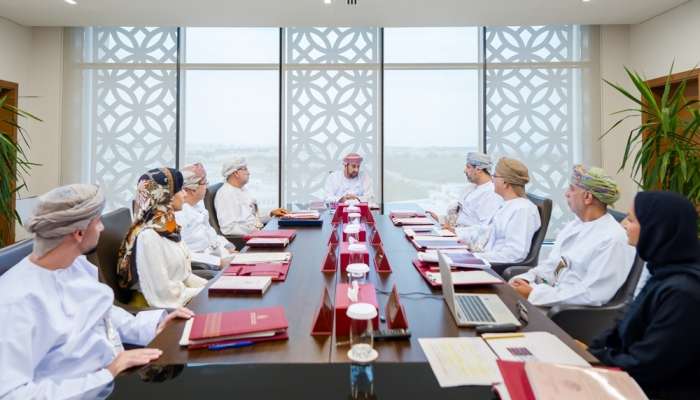
Muscat: The Board of Trustees of the Royal Academy of Management (RAM) held its first meeting of 2026, chaired by Sayyid Khalid Hilal Al Busaidi, Minister of Diwan of Royal Court and Chairman of the Board of Trustees.
The Board reviewed institutional performance in 2025, approved the Annual Plan for 2026 and considered this year’s priorities, including the Oman Global Economic Integration Initiative, Future Readiness Framework, and the seamless integration of AI into RAM’s programmes and across the value chain.
Al Busaidi highlighted RAM’s progress and measurable impact over the past year.
He praised RAM’s performance, noting its demonstrated results and contributions to a strategic shift in Oman’s leadership and administrative landscape.
He emphasised that RAM’s continued focus on developing national leadership capability and embedding modern knowledge, including through partnerships with leading local and international institutions, reflects the Royal Vision of His Majesty Sultan Haitham bin Tarik, which places investment in Oman’s human capital development at the centre of national priorities and future readiness.
The Board Members reviewed RAM’s overall institutional performance and achievements in the year 2025, which were guided by an integrated operating model focused on building effective leadership communities aligned with Oman’s future priorities.
The model was implemented through a range of initiatives, including structured executive programmes, national initiatives, applied studies, and curated dialogues, designed around a systematic learning philosophy informed by global best practices and grounded in local context. RAM also delivered specialised studies on future readiness, alongside research related to local governance, decentralisation, and administration.
Reflecting RAM’s growing impact on leadership development, the Board of Trustees noted the expansion of RAM’s reach across leadership levels, with its total alumni exceeding 2,258.
Particular emphasis was placed on the development of leadership communities through the launch of RAM’s Alumni Platform, a professional network that supports knowledge exchange, sustains learning outcomes, and integrates alumni insights into RAM’s ongoing initiatives.
RAM’s contributing role in strengthening regional cooperation among GCC member states through the Future of Work in Government Programme was also recognised by its Board of Trustees.
The first edition of this bespoke programme delivered strong outcomes, engaging 65 senior leaders from GCC member states and the GCC Secretariat General.
Building on these excellent results, the Board confirmed RAM’s initiative to launch a second edition of its GCC programme under the theme Future Readiness, further reinforcing its role in advancing regional leadership capability and administrative collaboration.
During the meeting, RAM’s achievements in 2025 were highlighted as a testament to its commitment to enhancing leadership capacity across the public and private sectors, as well as society at large, supported by strategic local and international partnerships.
The Board of Trustees also noted RAM’s growing media presence across the GCC, wider region, and internationally.
Turning to future priorities, the meeting discussed RAM’s priorities for 2026, including continued work on the Oman Global Economic Integration Initiative.
Aiming to further strengthen Oman’s economic presence and strategic partnerships, the initiative will focus on supporting trade expansion and structured engagement with international organisations, in coordination with relevant government entities as well as the public and private sectors.
RAM has also established a Future Readiness Framework and is progressing work on a national methodology for measuring future readiness, developed in collaboration with local and international economic experts. This initiative aims to support decision-making and enhance institutional preparedness for long-term transformation.
RAM will also integrate artificial intelligence (AI) applications into selected programmes and across the value chain, aiming to further improve efficiency, enhance learning outcomes, and align with global developments in executive education, where AI is increasingly positioned not merely as a technology but as a strategic leadership capability.
The meeting of the Board of Trustees concluded with the approval of RAM’s Annual Plan for 2026, which encompasses a coordinated portfolio of programmes, initiatives, and studies that will be delivered through innovative approaches and in collaboration with leading international institutions. -ONA