Wednesday 04 / March / 2026
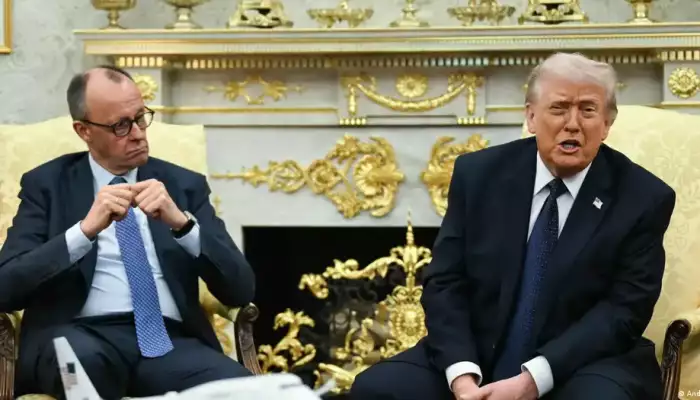
New York: Merz and Trump spoke to the press for around 35 minutes in the Oval Office.
However, the breakdown of the time that each spoke showed just how one-sided the bilateral talks were.
According to the dpa news agency, Trump took up the vast majority of the time, speaking for at least 30 minutes and often repeating himself.
Merz spoke for just three minutes, even when some of the questions from the press were directed at him.
Despite the unbalance, Merz was able to use his limited time to highlight the issues at the top of his agenda.
And as a result, Trump declared Merz to be a "friend." It remains to be seen how well his Oval Office appearance played at home, but it likely won't be too different from his previous meeting with Trump in the White House, where Merz also only spoke for a total of three minutes.
DW's chief political editor Michaela Kuefner managed to get in a question to Trump and Merz about how much European nations have supported the US in its war against Iran.
Trump responded by saying some European countries, such as Germany, have been helpful, but others, such as Spain have not.
Merz tells Trump Ukraine must 'preserve its territory'
During his press conference with Trump, Merz appeared to be seeking to show he was on the side of the US president while gently pushing him on certain issues.
One was to consider what will happen in the Middle East in the medium- to long-term. The other was Ukraine.
"We all want to see this war coming to an end as soon as possible," Merz said.
"But Ukraine has to preserve its territory and their security interests and well, we will talk about that," he added.
A previous ceasefire proposal coming from the White House had offered up Ukrainian land to Russia, including land that was not under Russian control. This had sparked a heated response from European partners at the time.
"We are on the same page: This terrible regime in Tehran must go. We will talk about the day after. And we must talk about Ukraine. We want an end to these wars," Merz wrote on X after the meeting.
Merz and Trump talk unity on Iran and Ukraine
Merz was clearly trying to push Trump to discuss long-term plans for Iran, saying: "We have to strategize on this entire region."
He stressed the importance of a "common approach" that includes the security for the US, Europe and Israel.
Asked about Ukraine, Trump said it was "very high" on his priority list, but admitted he'd been surprised at how difficult it has been to find a solution to end the war.
"I thought it was going to be one of the easier ones," he told reporters before repeating the false claim that he has already settled eight wars in his second term.
As for how the ceasefire process was going between Ukraine and Russia, Trump said: "Sometimes I blame one, sometimes I blame the other one," but was adamant a deal was going to happen.
Trump calls Merz a 'friend'
Despite no clear offering of an improvement on US tariffs, one of the major goals of the Merz trip, Trump said his German counterpart was "doing a very good job ... a really great job."
He went on to call the chancellor a "very, very successful man" and a "friend."
The US president said the US and Germany were getting along well, but he didn't have such kind words for the UK or Spain, which he called "uncooperative."
With the UK, he complained about the decision to not let the US use its bases to attack Iran. He also criticized UK policies on energy and immigration, making several unsubstantiated claims.
Merz hoping for a quick end to the war in Iran
Following long-winding remarks from Trump about his purported successes, Merz spoke of his hope for a quick end to the war.
The rising price of gas and oil since Saturday's attacks "is of course damaging our economies," Merz said.
"That's the reason why we all hope that this war will come to an end as soon as possible and we are hoping that the Israeli and the American armies are doing the right things to bring this to an end," he added, expressing hope for a "new government" in Iran.
Trump predicted that after the war oil prices would drop, "I believe lower even than before."
As for what could happen "the day after," Trump had less to say.
"I guess the worst case would be, we do this, and then somebody takes over who's as bad as the previous person, right?" he told reporters. "That could happen. We don't want that to happen."
"Lots of the people we had in mind are dead," he said.
As for Reza Pahlavi, the son of the former shah who was overthrown in the 1979 revolution, Trump said: "I've said that he looks like a very nice person, but it would seem to me that somebody that's there that's currently popular, if there's such a person, but we have people like that."
SPD, Greens call on Merz to push Trump on Iran
Questions have emerged among German political parties over the US attacks on Iran ahead of Merz's meeting with Trump.
Matthias Miersch, the general secretary of the center-left SPD that rules in a coalition with Merz's own Union, said that the meeting offered an opportunity to ask Trump about the US "strategy."
"For us it's clear that, according to everything we know, at the moment, international law is not being abided by," Miersch said. "And that must be stated, especially for states that are dependent on the continued existence of the international order."
The SPD chief added that "no tears are being shed for the regime" in Iran.
The opposition Greens also called for Merz to request an explanation from Trump on his strategy.
"What is the strategy now? What does the future hold for the people in the Middle East?" Green parliamentary leader Britta Hasselmann said.
"We as Europeans must make it clear to the Trump administration that it is in our interest to stand together in the international community for a rules-based order for the rule of law, for democracy and also for international law for the future," Hasselmann said, adding that the US-Israeli attack on Saturday had "no mandate under international law."
What has changed since Merz's last visit to Washington?
Friedrich Merz visited Donald Trump in the White House for the first time in June of last year.
While the chancellor said after the meeting that he was "extremely satisfied" with how they went, the talking points have, in many ways, not changed. The obvious exception is the war against Iran that broke out on Saturday morning.
But Trump's tariff policies are once again on the docket despite the US and EU coming to an agreement last year. After the Supreme Court declared the tariffs illegal, Trump responded by declaring a new flat rate of 15% tariffs on all trading partners. As such, the EU has paused its ratification of the agreement as it waits to see what will happen with the new tariffs.
The war in Ukraine, now going on for more than four years, also remains a key yet unresolved issue. Trump has been much less supportive of Ukraine in comparison to his predecessor and to his European allies. Attempts to work out a peace agreement with Russia have proved fruitless, even as early versions of the agreement looked ready to concede swathes of land to Russia.
Another issue that gained prominence since their last meeting is the question of Greenland, which Trump has repeatedly, since his first term, said he wants to acquire for the US as a matter of security. This brought US-European relations to their lowest point, with some NATO members asking whether they would be called to war against the US should it attempt to take the semiautonomous Danish territory by force.
However, it remains to be seen whether Merz will bring up this thorny issue in his meeting with Trump. The talks have been scheduled to last for thirty minutes but will likely spill over.