Sunday 31 / May / 2026
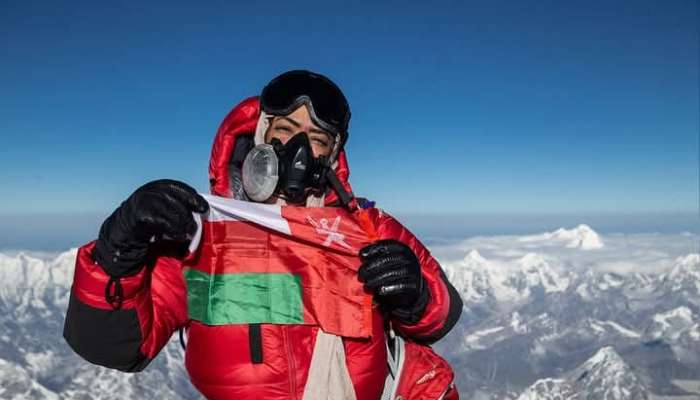
Muscat: Omani woman mountaineer Nadira Al Harthy delivered a deeply personal and inspiring account of her journey from the mountains of Oman to the summit of Mount Everest during a ceremony organised by the Embassy of Nepal in Oman to mark Sagarmatha Day, also known as Mount Everest Day.
Speaking before diplomats, adventurers and members of the Nepali and Omani communities recently, Al Harthy reflected on the challenges, failures, sacrifices and dreams that shaped her transformation from an ordinary government employee into one of Oman’s leading mountaineers.
“Every day I see more Omani faces joining the world of adventure and exploration,” she said. “Let us celebrate Everest Day together and keep Everest as a dream for all of us.”
Nadira introduced herself as an employee at the Ministry of Education and proudly spoke about her roots in Oman’s Sharqiyah region. She explained that mountaineering was not part of her childhood ambitions and that her passion for climbing developed only recently.
According to her, the turning point came after hearing the story of Khalid Al Siyabi, the first Omani to summit Mount Everest in 2010.
“We always wait for someone to open the door for us,” she said. “If somebody can do it, then I can do it too. When Khalid climbed Everest, I believed I could also reach there one day.”
She described how her training began on local mountains in Oman, especially Jabal Shams, before she set her sights directly on Everest. Despite having no previous experience in major international climbs, she dedicated herself completely to physical and mental preparation inside Oman. “All my hard work happened here in Oman,” she said. “I wanted to learn everything here before facing the fears and dangers of Everest.”
She spoke openly about the emotional and physical struggles she experienced during her preparation. She recalled participating in her first marathon in Muscat in 2018 and joining the demanding Oman by UTMB ultra-trail race despite barely understanding the sport at the time.
The 142-kilometre mountain race proved to be one of her hardest moments. She managed to complete around 90 kilometres before withdrawing from the competition in exhaustion.
“I drove home crying the whole way,” she recalled. “I asked myself: if I cannot do this in Oman, how will I ever climb Everest?”
Yet she said those moments of failure became the foundation of her determination.
“I learned that if I was not ready to fail, I would never be ready to succeed,” she said.
Her journey eventually took her to Everest Base Camp at an altitude of more than 5,300 metres, where she spent nearly 50 days living in harsh conditions inside a small tent.
“There were no luxuries, no showers, freezing temperatures and endless waiting,” she said. “But I stayed positive all the time. I kept telling myself that I had already come so far.”
She explained that while many climbers at Everest had already completed some of the world’s most difficult mountains, she quietly carried the fact that Everest was her first major international climb.
“I did not compare myself to others,” she said. “I focused only on my dream.”
On May 23, 2019, Nadira Al Harthy successfully reached the summit of Mount Everest.
The achievement came alongside a meaningful reunion with late Khalid Al Siyabi, who returned to Everest that same year. She recalled how he had encouraged her from the beginning with a simple but powerful message: “Yes, you can.”
Nadira Al Harthy shared one of the last messages she received from Al Siyabi before her summit push.
The message read: “Someday, when things are okay, you will look back and feel proud that you did not give up.”
“Today, whenever I speak about Everest, I remember those words,” she said emotionally. “Alhamdulillah, I did not give up.”
She also paid tribute to Al Siyabi after his passing by carrying his memory and name with her during later climbs.
During the speech, Al Harthy described the brutal realities of high-altitude mountaineering, including violent storms, exhaustion, frostbite and the constant threat of death.
“It is not only about carrying the Omani flag on the summit,” she said. “Behind every photo there are nights of fear, pain, loneliness and sacrifice.”
She recalled losing fellow climbers during expeditions, including Afghan climber Ali Akbar during an attempt on K2 and Sherpa companions in the mountains of Pakistan.
“Sometimes we see bodies on the mountains,” she said quietly. “We all share the same dream, but the mountains remind us how fragile life can be.”
Following her Everest success, Nadira continued pursuing some of the world’s most difficult peaks. She became the first Arab woman to climb Ama Dablam and also summited Manaslu, the world’s eighth-highest mountain.
She later conquered K2 — widely considered one of the most dangerous mountains in the world — before climbing Gasherbrum II and Nanga Parbat, known as the “Killer Mountain.”
Despite the dangers, she said mountaineering taught her valuable lessons about resilience, humility and human connection.
She spoke warmly about the friendships formed on mountains, sharing simple meals with climbers from different countries and learning about cultures and communities through travel and exploration.
Nadira also highlighted the importance of encouraging younger generations in Oman to explore nature and outdoor activities responsibly. Through programmes organised with the Ministry of Education and local adventure groups, she has helped introduce students to hiking and mountain exploration across Oman.
“We still have so much to learn from nature,” she said. “Every mountain teaches us something new.”
She concluded her speech with a message of hope and encouragement for everyone pursuing personal ambitions.
“We all have our own Everest,” she said. “Maybe your Everest is different from mine, but dreams can become reality if we keep believing and never give up.”