Tuesday 28 / July / 2026
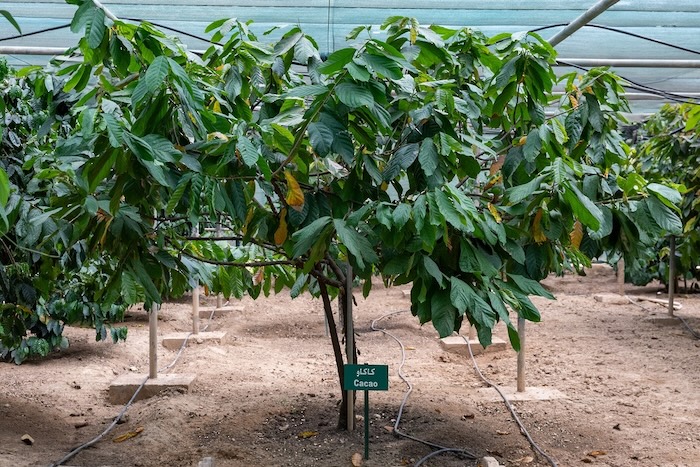
Muscat: The Qayrun Hairiti Farm in Dhofar Governorate, under the auspices of the Royal Court Affairs, has successfully cultivated cocoa after more than a decade of development, research, and propagation.
The cocoa tree is a tropical, evergreen tree that requires meticulous care throughout its growth stages. Its fruit grows on the trunk in the form of pods, and its colour changes as it ripens.
Engineer Mohammed bin Ahmed Al Mashikhi, Head of the Agricultural Services Department, stated that the cocoa tree is one of the most prominent tropical crops with high economic value.
He noted that the cultivation process at the Qayrun Hairiti Farm began in 2016 to assess its viability under the climatic conditions of Dhofar Governorate.
Al Mashikhi added that the harvest season in September is the best time for planting cacao due to the high temperatures and humidity. Flowering occurs in February and March, while the harvest takes place in September and October. Cacao trees range in height from 3 to 8 meters, and their height is controlled by pruning. The fruit itself is between 15 and 25 centimeters long.
Al Mashikhi, explained that during the harvest, the cacao beans are extracted and then undergo a fermentation process for several days. Following this, they are dried, roasted, and ground. Cacao powder is used in various industries, most notably in chocolate production, some pharmaceuticals, and certain cosmetics. The outer husk is used as organic fertilizer.
Regarding the care of cacao trees, Engineer Salem bin Ahmed Al Shahri, a plant protection specialist, stated that the cacao trees at the Qayrun Hayriti farm receive continuous monitoring and care to protect them from various pests and maintain the quality of the fruit.
He added that the most prominent pests affecting the plant are aphids and thrips, which are controlled biologically using predators such as the oryx and the aphid lion, which are bred and reared in the farm's biological control laboratory. Natural predators such as ladybugs and the parasite Aedes are also present.
It is worth noting that the success of the Royal Gardens and Farms, under the auspices of the Royal Court Affairs, in cultivating cocoa at the Qayrun Hairiti farm in the Dhofar Governorate represents a significant addition to the agricultural experiments for tropical crops in the governorate and opens promising economic prospects in the agricultural sector in the Sultanate of Oman.