Sunday 02 / August / 2026
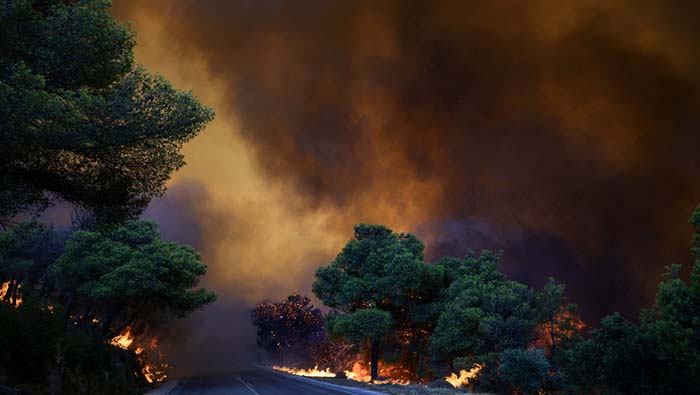
Athens: Europe has witnessed widespread wildfires this summer following successive heatwaves that have broken temperature records, coupled with a severe shortage of rainfall. Villages in France and Spain have been devastated, and hundreds of thousands of people have been forced to evacuate their homes and holiday accommodations.
Wildfires, fanned by strong winds, have swept through several regions of Greece, including areas near Athens, as authorities continue large-scale firefighting operations and evacuation efforts, while conditions have once again deteriorated in parts of Spain and France.
Firefighters, police, and emergency medical personnel withdrew slowly as a wall of fire and smoke advanced, engulfing forests and trees near Porto Germeno, overlooking the Gulf of Corinth, approximately 60 kilometres northwest of the Greek capital.
To the northwest of Athens, authorities ordered residents of the towns of Agia Paraskevi, Kryo Pigadi, and Agios Nektarios to evacuate. Helicopters dropped water and fire-retardant materials in an attempt to halt the spread of the blaze.
Earlier, more than 200 people from the town of Agios Vasileios were forced to evacuate by sea.
Authorities have warned of an extreme risk of wildfires in the regions of Boeotia, Attica, and Euboea.
In France, a fire reignited in the mountainous Var department three days after it had been brought under control, spreading to more than 1,000 hectares within six hours.
In the town of Montfort-sur-Argens, in the Var department, local farmers assisted by filling firefighting trucks and helicopters with water.
Spain continues to battle several active fire fronts, two days after the government declared an end to the national state of emergency triggered by massive wildfires in regions across central Spain.
Authorities reported that conditions had worsened in the province of León, where a new fire broke out, while another blaze remained active, and a third showed positive developments.
In the neighbouring province of Zamora, conditions improved in a fire that had consumed some 11,000 hectares, allowing the reopening of 14 previously evacuated towns and the lifting of restrictions imposed on them.
In the province of Castellón, the Vall d'Uixó fire was contained on its seventh day after burning approximately 10,000 hectares, enabling all evacuated residents to return to their homes.
Police have stated that they suspect the fire was deliberately set, after discovering two separate ignition points.
Major fires in the regions of Madrid and Ávila, which had burned more than 70,000 hectares, have also been contained, despite a new outbreak near the San Juan reservoir.
In Austria, the national agency for health and food safety reported a record 395 heat-related deaths during June.
Nearly half of Austria's meteorological stations recorded temperatures of at least 35 degrees Celsius during June, while 15 stations registered temperatures of 39 degrees Celsius or higher.
The United Kingdom reported an estimated 2,877 heat-related deaths since the beginning of the year, while France recorded 5,764 excess deaths above the usual average between 17 June and 2 July.
Germany's Robert Koch Institute for Health estimated that 9,800 people have died since the start of the year due to extreme temperatures.