Sunday 15 / November / 2026
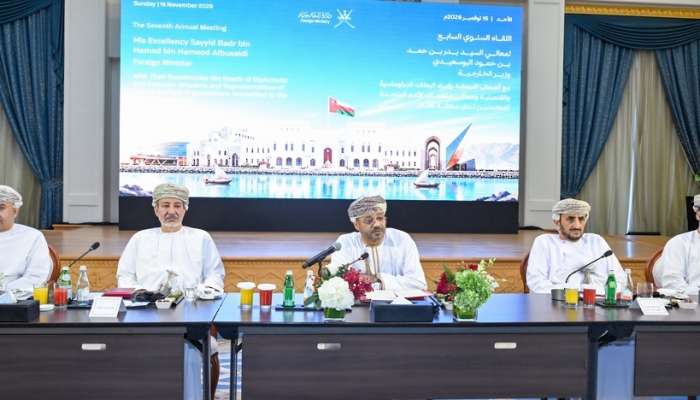
Muscat --- Sayyid Badr bin Hamad Al Busaidi, Foreign Minister, held today at the Diplomatic Club in Muscat the seventh annual meeting with the ambassadors and heads of diplomatic missions and international organizations accredited to the Sultanate of Oman.
This meeting comes within the framework of enhancing communication and dialogue regarding regional and international developments, and the prospects for cooperation and partnership in the economic and technological fields, in a manner that keeps pace with national development priorities and "Oman Vision 2040".
The Foreign Minister expressed his thanks and appreciation to the heads of missions for their efforts over the past year and their contributions to developing political, economic, and cultural relations with the Sultanate of Oman. He affirmed that these efforts are appreciated by various Omani government institutions, stemming from the importance of international partnerships in supporting the march of national development and enhancing the foundations of prosperity and stability.
On the political front, the Foreign Minister addressed the challenges witnessed by the region and the diplomatic efforts exerted to de-escalate and create the conditions to reach peaceful settlements through negotiation. He expressed the Sultanate of Oman's appreciation to friendly and partner countries that contribute to supporting these endeavors, and the efforts and resources they expend toward containing tensions and enhancing opportunities for peace.
In the economic and developmental aspect, the Foreign Minister reviewed the attention given to the fields of technological innovation and sustainable economic growth in the national policy of the Sultanate of Oman. He pointed out that these priorities were primarily present during the visits of His Majesty Sultan Haitham bin Tarik to a number of Arab and friendly countries, as well as His Majesty's meetings with a number of leaders and presidents.
He clarified that these visits and talks resulted in important agreements in a number of vital sectors, including renewable energy, logistics services, space exploration, water resources, startups, communications and information technology, and artificial intelligence. This is in harmony with the targets of Oman Vision 2040 and the Sultanate of Oman's aspirations to build a more dynamic economy based on knowledge, innovation, and the development of modern technologies.
In this context, he pointed to the National Program for Digital Economy for the period 2026–2030, and its associated initiatives aimed at enhancing the Sultanate of Oman's presence in the fields of the digital economy and empowering it to contribute actively to the development of modern technologies.
In a related context, the Foreign Minister touched upon the accelerating transformations in the field of artificial intelligence and the vast opportunities it provides for scientific, economic, and human progress. He affirmed the importance of the international community playing an active role in directing these technologies toward serving humanity and achieving sustainable development.
Sayyid Badr drew attention to the importance of making the benefits of artificial intelligence available in a fair and comprehensive manner to all countries and societies, and working on establishing common frameworks and rules to regulate its development and uses.
Further, he affirmed that international cooperation and partnerships based on the exchange of expertise and knowledge represent a fundamental pillar for ensuring that all of humanity benefits from technological developments. He pointed out what the Sultanate of Oman can contribute in terms of human capabilities, the spirit of initiative and innovation, and building partnerships in the development of artificial intelligence technologies and directing them toward meeting human needs and aspirations.
In the context of this occasion, which brings together all heads of diplomatic missions accredited to the Sultanate of Oman, and upon an invitation from the Foreign Ministry, Ahmed bin Saleh Al Rashdi, Undersecretary of the Ministry of Endowments and Religious Affairs, participated by providing a briefing to the attendees on the Muscat Plan. He outlined its objectives and pillars aimed at combating hate speech and preventing conflicts and mass atrocities through dialogue, mediation, and peacebuilding, in a manner that enhances understanding, peaceful coexistence, and societal cohesion.
The meeting was attended by Sheikh Abdulaziz Abdullah Al Hinai, Ambassador-at-Large at the Foreign Ministry; Sheikh Khalifa Ali Al Harthy, Undersecretary of the Foreign Ministry for Political Affairs; and Sheikh Khalid bin Hashel Al Muselhi, Undersecretary of the Foreign Ministry for Administrative and Financial Affairs, alongside a number of ambassadors and officials at the Foreign Ministry.