Wednesday 18 / November / 2026
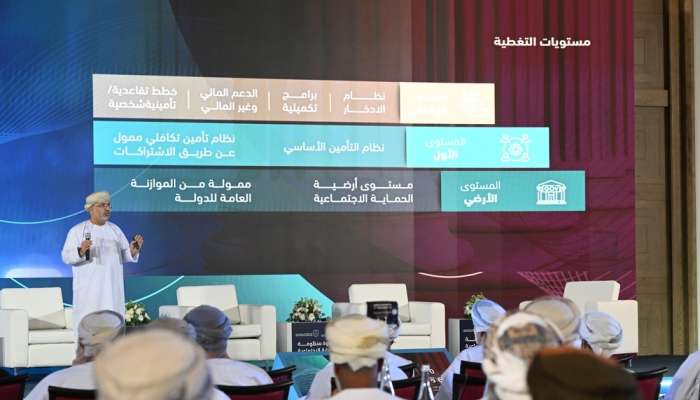
Muscat--- The Social Protection Fund (SPF) continues to implement a comprehensive framework whose coverage has expanded to over 1.7 million active insured individuals. Its benefits reach more than 1.25 million children, alongside senior citizens, persons with disabilities, and eligible low-income families.
This expansion stems from the legislative and institutional transformation witnessed by the social protection system in recent years. It embodies the Royal care bestowed by His Majesty Sultan Haitham bin Tarik upon human well-being and family stability, in alignment with the national priorities of Oman Vision 2040.
The year 2026 saw the continued broadening of insurance coverage and the rollout of sick and extraordinary leave insurance. It also marked notable progress in global pension indices, alongside initiatives to strengthen performance measurement and elevate the beneficiary experience. These developments underscore a unified legislative and institutional system serving children, senior citizens, persons with disabilities, eligible households, employees, and employers by integrating non-contributory social benefits with contributory social insurance programs.
Established under Royal Decree No. 33/2021, the Social Protection Fund completed its regulatory architecture with the issuance of the Fund’s Bylaw under Royal Decree No. 50/2023 and the Social Protection Law under Royal Decree No. 52/2023. These enactments laid the foundation for a cohesive framework that combines statutorily funded social benefits with contributory social insurance, savings schemes, and complementary programs, clearly defining rights, obligations, and eligibility criteria for each tier.
The transformation encompassed unifying pension funds and schemes under the new national umbrella, re-engineering business processes, upgrading databases and benefit administration mechanisms and integrating service delivery with insurance and financial operations.
This structure enables the management of diverse programs within a single institutional entity while accounting for the distinct nature and funding sources of social benefits versus social insurance schemes. While the Social Protection Law and its executive regulations stipulate eligibility rules, rights and obligations, the Fund is mandated to enforce these provisions, administer benefits and insurance, deliver services and evaluate programs for continuous enhancement.
A defining hallmark of the framework is its lifecycle approach to protection, which extends beyond retirement or specific demographics to support individuals from childhood through working years and family formation. It addresses social, occupational and health risks all the way into senior adulthood. The social benefits system encompasses the Elderly Benefit, Childhood Benefit, Persons with Disabilities Benefit, Orphans and Widows Benefit and Family Income Support Benefit, operating alongside work- and life-related social insurance programs.
By the end of October 2026, active beneficiaries of the Childhood Benefit reached 1,258,605, while the Elderly Benefit served 171,475 individuals and the Persons with Disabilities Benefit reached 55,078 recipients. Additionally, the Orphans Benefit covered 10,031 beneficiaries, and the Widows Benefit supported 5,605 women. These figures reflect the vast operational responsibility of ensuring timely benefit disbursements, maintaining accurate eligibility records and facilitating seamless access to services.
On the insurance front, active insured individuals totaled 1,702,934 by the end of October 2026, comprising 638,881 Omani nationals and 1,064,053 expatriates, alongside more than 141,000 active employers. This broad reach highlights the system’s deep integration with the labour market and national economy, requiring high efficiency in managing contributions, data, and coverage.
Social insurance programs cover old age, disability, and death; work injuries and occupational diseases; job security; maternity; and sick and extraordinary leave, subject to the scope and provisions of each branch. Launched on 19 July 2026, the sick and extraordinary leave insurance branch provides income replacement during covered temporary absences from work, demonstrating the expanding role of social insurance in mitigating career-related risks.
These programs directly reinforce family stability, as childhood, elderly, disability and family income benefits meet the essential needs of eligible groups, while maternity, sickness and occupational hazard insurance ensure income continuity for workers and their dependents. Consequently, benefit adequacy, accessibility and regulatory clarity remain central areas for ongoing evaluation and development.
As coverage grows, service quality, procedural accuracy and access to information become increasingly vital. According to the latest 2026 indicators, the Fund’s services now reach approximately 3.5 million citizens and residents. During the year, the Fund recorded 333,727 customer engagements across its various channels, including 228,274 visitors at regional Social Protection Departments and 192,258 calls handled by the contact center. Teams also executed 4,672 field services and 3,543 proactive services, complemented by community outreach initiatives.
Service delivery spans 11 regional Social Protection Departments across the governorates and three service outlets, alongside the contact center, electronic portal, the Himaya mobile application, digital channels and field teams. This multi-channel network is critical to accommodating diverse beneficiary needs, particularly for senior citizens, persons with disabilities and individuals facing mobility barriers.
To involve customers in service improvement, the Fund’s annual Customer Forum across the governorates translated beneficiary feedback into tangible upgrades. Out of 19 proposals logged during the 2024 and 2025 editions, 15 were implemented—representing a 78.9 percent execution rate—across direct communication channels, automated response systems, the contact center and e-services. Forum participation surged by 94 percent, reflecting growing public engagement and enabling the Fund to continuously refine the beneficiary journey.
In digital transformation, sustained efforts raised the Fund’s service digitization rate from 81 percent in 2024 to 89 percent in 2025, while the Himaya app surpassed 200,000 users by early November 2026. Upgrades included launching new services on the Unified Government Portal, enhancing contact center capabilities and strengthening technical infrastructure and system integration to streamline procedures and minimize the need for in-person visits.
Reinforcing its quality management framework, the Fund obtained International Organization for Standardization (ISO) certifications in July 2026 covering quality management, complaints handling and contact center operations across its regional branches. These accreditations reflect standardized follow-up, response and improvement protocols aimed at enhancing clarity, service efficiency and user satisfaction.
Internationally, Oman’s pension system advanced in the 2026 Mercer CFA Institute Global Pension Index, with its overall score rising from 61 points in 2025 to 69.9 points. Moving from a C+ to a B grade, Oman was among only five pension systems globally to achieve a rating upgrade in this edition, scoring 80.3 points in the adequacy sub-index to secure an A grade in that category.
The index evaluates retirement income systems across adequacy, sustainability and integrity, offering comparative benchmarks amid demographic shifts, economic dynamics and long-term pension liabilities.
In June 2026, the International Labour Organization (ILO) and the Social Protection Fund launched a joint report documenting the redesign of Oman’s social protection system, coinciding with the 114th Session of the International Labour Conference in Geneva. The report examined the transition toward an integrated, multi-tiered framework combining non-contributory benefits and contributory insurance across the lifecycle in alignment with international labor standards.
Furthermore, in October 2026, the Fund announced the development of a monitoring and evaluation framework in collaboration with the ILO and the United Nations Children’s Fund (UNICEF) to measure coverage, benefit adequacy and actual service access, linking performance indicators to institutional improvement.
Previously, in 2024, the Fund won the International Social Security Association (ISSA) Good Practice Award for Asia and the Pacific for expanding social protection coverage, alongside other institutional recognitions that support global knowledge exchange.
Long-term sustainability remains foundational to the system’s ability to honour current and future beneficiary entitlements. Achieving this requires prudent management of resources and long-term liabilities, growth of investment assets and enhanced collection and expenditure efficiency tailored to each program’s funding structure and risk profile.
Under its asset management framework, the Fund achieved a 10.4 percent investment return according to its latest approved 2026 performance results, calculated and presented in accordance with the Global Investment Performance Standards (GIPS) to ensure consistency, transparency and benchmark comparability.
The Fund manages its investments within approved governance frameworks to balance returns, risks and current and future obligations, relying on accurate performance disclosure, actuarial valuations and robust risk and compliance management to guide financial decisions. Guided by its 2026–2030 strategy, the Fund anchors financial sustainability alongside three interconnected pillars: social protection, strategic partnerships and institutional efficiency.
Looking ahead, priorities include completing program rollouts according to statutory timelines, expanding service accessibility, strengthening data and indicator integration, advancing impact measurement tools and elevating operational and financial governance amid evolving demographic and labour market trends.




