Thursday 26 / November / 2026
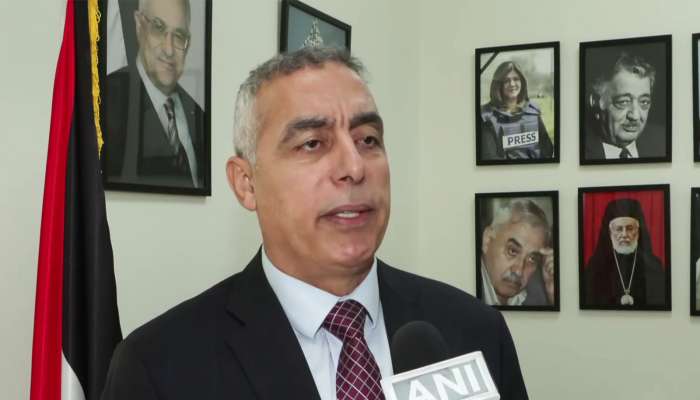
New Delhi : Palestinian Ambassador to India Abdullah M Abu Shawesh has welcomed India’s USD 2.5 million contribution to the United Nations Relief and Works Agency for Palestine Refugees in the Near East (UNRWA), describing it as an important show of political and financial support for Palestinians at a “very critical time”.
Handing over the contribution to UNRWA Senior Finance Assistant Khaled Hindeyyeh, Representative of India to the State of Palestine, Mahima Sikand, underlined the Indian government’s continued support for the Agency’s services and its provision of humanitarian assistance and medicines to help the Agency meet its responsibilities towards the welfare of Palestinian refugees in the region. Hindeyyeh expressed appreciation for the Government of India’s continued and longstanding political and financial support to the Agency.
UNRWA works to provides essential humanitarian aid and public services to Palestine refugees across Gaza, the West Bank, Jordan, Lebanon, and Syria. Established in 1949, the agency operates schools, primary health clinics, and social support programs on the ground. UNRWA relies primarily on voluntary contributions from UN Member States and intergovernmental organisations to carry out its mandate and operations, which accounted for more than 75 per cent of the Agency’s overall income in 2025.
In an interview with ANI, Abu Shawesh said India’s continued financial assistance to UNRWA and its support for Palestinian resolutions at the United Nations General Assembly reflected New Delhi’s longstanding commitment to the Palestinian cause.
“India stands strong to provide financial support, and it is a political support to India. This came at a very critical and very important time,” the Ambassador told ANI.
India’s latest contribution of USD 2.5 million is part of its annual USD 5 million commitment to UNRWA for 2026-27. The funding will support the agency’s core programmes, including education, healthcare and relief efforts for Palestinian refugees.
Abu Shawesh said India had consistently supported Palestinian rights, including their right to welfare and return, and expressed gratitude for New Delhi’s backing at international forums.
“Just two or three days ago, India voted in favour of many resolutions in the United Nations General Assembly in favour of the Palestinian people. This is how we judge India-Palestine relations at a practical level,” he said.
Abu Shawesh said Palestine had never interfered in India’s bilateral relations with Israel and believed New Delhi could use its relationship with Tel Aviv to advance the peace process and the two-state solution.
“We did not interfere when it came to India-Israel relations. Our opinion has been, and will continue to be, that India is a great country. India having good relations with Israel is something we can utilise for our benefit, particularly when it comes to the two-state solution and the peace process,” he said.
Recalling the establishment of diplomatic relations between India and Israel, the Ambassador said the then Congress government had consulted late Palestinian leader Yasser Arafat on the issue.
However, he stressed that the October 7 attacks should not be viewed in isolation from the broader history of the Palestinian conflict.
On the political situation in Israel following the recent elections, Abu Shawesh said neither the current government nor the opposition had offered a credible roadmap towards a two-state solution.
He said a meaningful change would require a genuine political process and renewed negotiations with the Palestinian Authority and the Palestine Liberation Organisation (PLO).
“The real change that we are looking for is to start a real political path and real political negotiations with the Palestinian Authority and the PLO, with whom Israel signed the Oslo Accords. Unfortunately, neither the current government nor the opposition led by Gadi Eisenkot is giving us this path for peace,” he said.